How Cohesive Bandage Sticks to Itself
Cohesive bandages stick to themselves through a process called autohesion — the ability of a material to bond with itself without sticking to skin, hair, or fur. The key ingredient is a natural latex rubber coating (or synthetic latex alternative) applied to an elastic fabric substrate. When two latex-coated surfaces are pressed together, the polymer chains in the latex interlock at a molecular level, creating a secure yet repositionable bond. No adhesive glue is involved. This is what makes cohesive bandages uniquely safe and versatile, especially in veterinary and equestrian applications.
The Science Behind Autohesion
Autohesion is fundamentally different from traditional pressure-sensitive adhesion. In a standard adhesive bandage, a glue layer bonds to whatever surface it contacts. In a cohesive bandage, the mechanism is entirely material-based:
- Polymer chain entanglement: Natural latex is composed of long, flexible polymer chains. When two coated surfaces meet under light compression, these chains physically entangle across the interface.
- Van der Waals forces: At close molecular distances, weak but cumulative intermolecular attractions (Van der Waals forces) add measurable bonding strength across the contact area.
- Surface energy matching: Latex surfaces have a similar surface energy to each other, which promotes bonding between like materials — but not to dissimilar surfaces like skin or hair.
- Elastic deformation: The stretchable fabric allows the bandage to conform under tension, maximizing the contact area between wraps and therefore maximizing bond strength.
In practice, wrapping one layer over another with even moderate tension — typically 30–50% stretch — is sufficient to activate a reliable self-bond. The bond is strong enough to stay in place during activity but weak enough to peel apart cleanly without damaging underlying tissue.
Key Materials That Make It Work
The performance of a cohesive bandage depends heavily on the quality and combination of its materials. Below is a breakdown of the typical composition:
| Component |
Material |
Function |
| Substrate fabric |
Nonwoven or woven elastic fiber (often nylon/spandex) |
Provides stretch, conformability, and breathability |
| Cohesive coating |
Natural latex or synthetic latex |
Creates the self-bonding autohesion layer |
| Liner |
Release paper or film |
Prevents bonding during storage on the roll |
| Colorant |
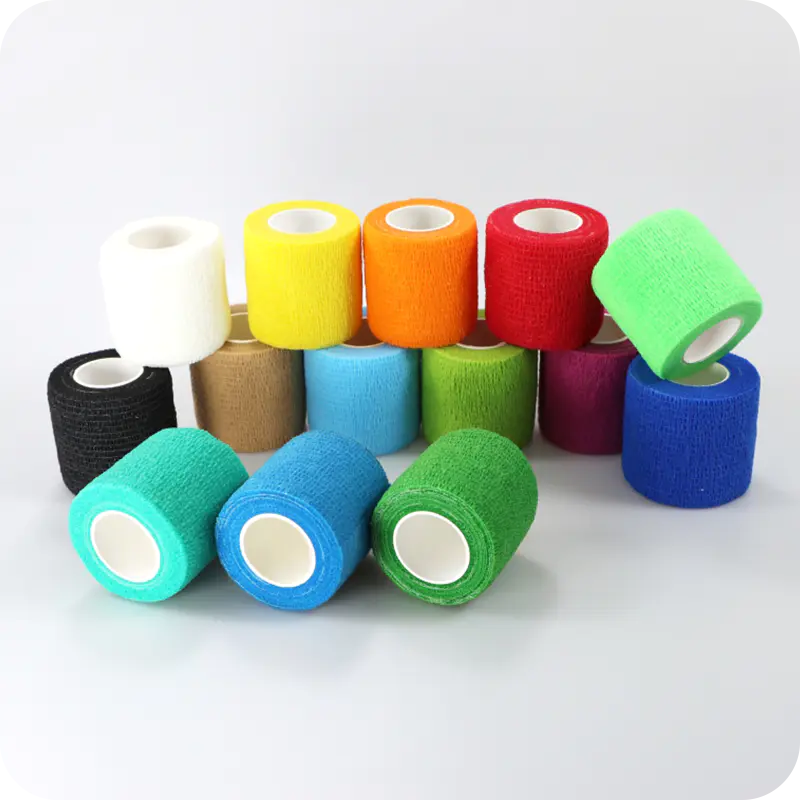
Non-toxic pigment |
Allows color-coding and identification |
Natural latex provides superior autohesion compared to synthetic alternatives due to its higher polymer chain mobility at room temperature. However, latex-free versions made with synthetic rubber compounds are widely available for users and animals with latex sensitivities.
Why It Doesn't Stick to Skin or Fur
This is one of the most practically important properties of cohesive bandages, especially when used on horses and other animals. The reason cohesive bandages do not adhere to skin, fur, or hair comes down to surface chemistry:
- Skin and hair surfaces are covered in oils (sebum), proteins, and moisture — all of which are chemically incompatible with the latex coating.
- These surface contaminants act as natural release layers, preventing the polymer chains from making close enough contact to form entanglements.
- The latex coating only bonds strongly to another latex-coated surface, because only those surfaces share the same surface energy and molecular structure.
This selectivity is the reason cohesive bandage for horses has become a standard tool in equine first aid and leg support. A horse's coat — even a thick winter coat — will not be pulled or damaged when the bandage is removed, making it far safer than traditional adhesive tapes for repeated or long-term use.
Factors That Affect Bond Strength
Not all wrapping conditions produce the same bond. Several variables directly influence how securely a cohesive bandage holds together:
Stretch Level During Application
Applying the bandage at 50–75% of maximum stretch is generally recommended for strong limb support. Too little stretch means minimal contact pressure and a weaker bond. Too much stretch can restrict circulation. For horses, most manufacturers recommend no more than 50% stretch to avoid over-tightening on legs.
Overlap Percentage
Each wrap should overlap the previous one by at least 50%. This doubles the bonded area and ensures the bandage functions as a unified layer rather than separate strips.
Temperature
Latex performs best at moderate temperatures. Below 5°C (41°F), the polymer chains become less mobile, reducing autohesion efficiency. In cold stable environments, it may help to warm the bandage briefly before application.
Surface Condition
Moisture, dust, or topical ointments on the underlying padding or skin can migrate onto the bandage surface and reduce bond quality. Always apply cohesive bandages over clean, dry protective padding.
Cohesive Bandage in Equine Use: Practical Considerations
In the horse care context, cohesive bandages serve a range of functions: leg wrapping for injury support, hoof protection, wound dressing retention, and post-exercise recovery. Their self-bonding mechanism is particularly valued because:
- No adhesive residue is left on the horse's leg hair or skin after removal.
- They can be removed and repositioned during application without losing effectiveness, unlike tape.
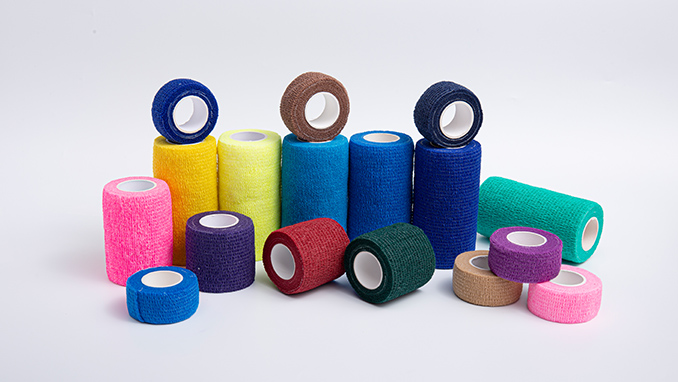
- Standard equine cohesive bandages are typically 4.5 meters long and 10 cm wide, providing enough coverage for a full lower leg wrap with multiple layers.
- They are compatible with a wide range of underlying materials — cotton, fleece, foam padding — as the bond only forms between the bandage's own latex layers.
One important caution: because the bandage bonds tightly to itself, it must be applied with consistent, even tension. Uneven application can create pressure points, which are particularly dangerous on a horse's lower leg where tendons and blood vessels lie close to the surface.
Latex vs. Latex-Free Cohesive Bandages: What Changes?
For users or animals with latex sensitivity, latex-free cohesive bandages use synthetic rubber compounds such as thermoplastic elastomers (TPE) or polyurethane-based coatings. Here is how they compare:
| Property |
Natural Latex |
Latex-Free (Synthetic) |
| Autohesion strength |
High |
Moderate to High |
| Cold weather performance |
Moderate |
Generally better |
| Allergy risk |
Present for latex-sensitive individuals |
Minimal |
| Shelf life |
2–3 years typical |
Up to 5 years in some formulations |
| Cost |
Generally lower |
Slightly higher |
In most equine applications, natural latex bandages remain the standard due to their superior autohesion and cost efficiency. Latex-free options are preferred in veterinary clinics where handlers with latex allergies may be present.
How to Store Cohesive Bandages to Preserve Adhesion
Since the self-bonding property is entirely material-based, it can degrade if the bandage is stored incorrectly. Follow these guidelines to maintain full effectiveness:
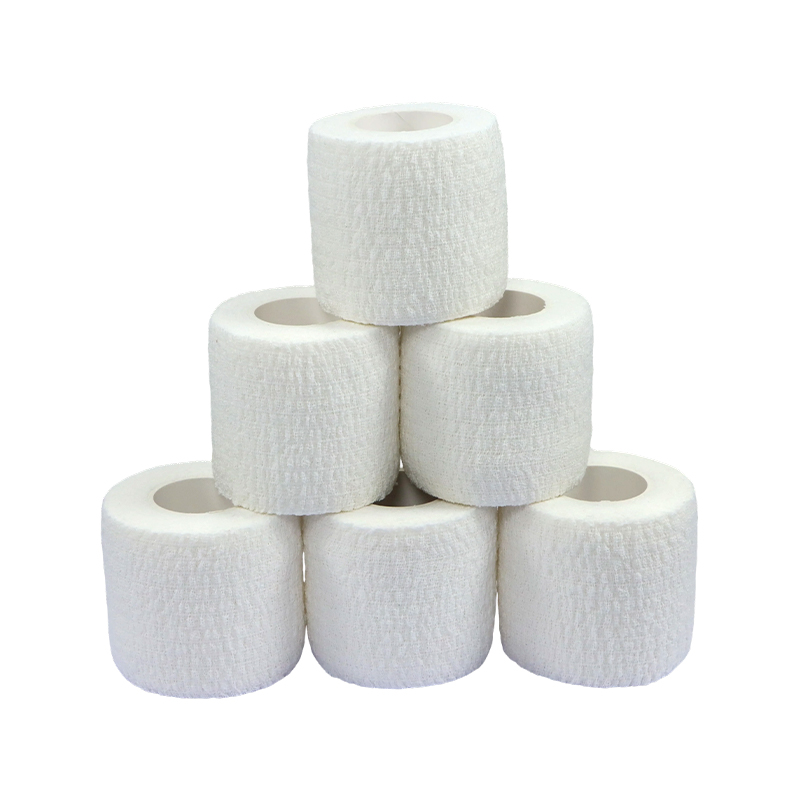
- Keep bandages in their original packaging until use — the release liner on the roll prevents premature bonding.
- Store at room temperature (15–25°C / 59–77°F) away from direct sunlight, which degrades latex over time.
- Avoid humid environments above 70% relative humidity, as moisture absorption can interfere with the latex surface.
- Do not stack heavy items on top of bandage rolls, as sustained compression can partially activate the self-bond prematurely.
- Check the expiry date — most cohesive bandages have a shelf life of 2–5 years depending on formulation.
FAQ: Cohesive Bandage for Horses
Q1: Can I reuse a cohesive bandage after it has been unwrapped?
Reuse is generally not recommended. Once unrolled and applied, the latex surface may pick up dust, hair, or oils that reduce autohesion. For wound care or medical use, always use a fresh bandage.
Q2: How tight should I wrap a cohesive bandage on a horse's leg?
Apply at no more than 50% stretch over a layer of protective padding. You should be able to slide a finger under the wrap without forcing it. Over-tightening can damage tendons and restrict circulation.
Q3: Does a cohesive bandage work when wet?
Autohesion is reduced when the bandage is saturated with water. Cohesive bandages are not designed for aquatic use. If the horse is in wet conditions, check and replace the bandage more frequently.
Q4: Why does my cohesive bandage not stick well in winter?
Cold temperatures reduce latex polymer mobility, weakening the self-bond. Warming the bandage to room temperature before application restores normal adhesion performance.
Q5: Is cohesive bandage safe to use directly on a horse's skin?
It will not stick to the coat or skin, but direct application over bare skin or an open wound is not recommended without appropriate wound dressings underneath. Always use a primary wound pad and cotton layer first.
Q6: How long can a cohesive bandage safely stay on a horse's leg?
For support wrapping, 12–24 hours is the typical maximum before the bandage should be removed, the leg checked, and a fresh bandage applied if needed. Never leave a bandage on for more than 24 hours without inspection.






 English
  русский
  Français
  Español
  عربى
عربى 

 ENG
ENG